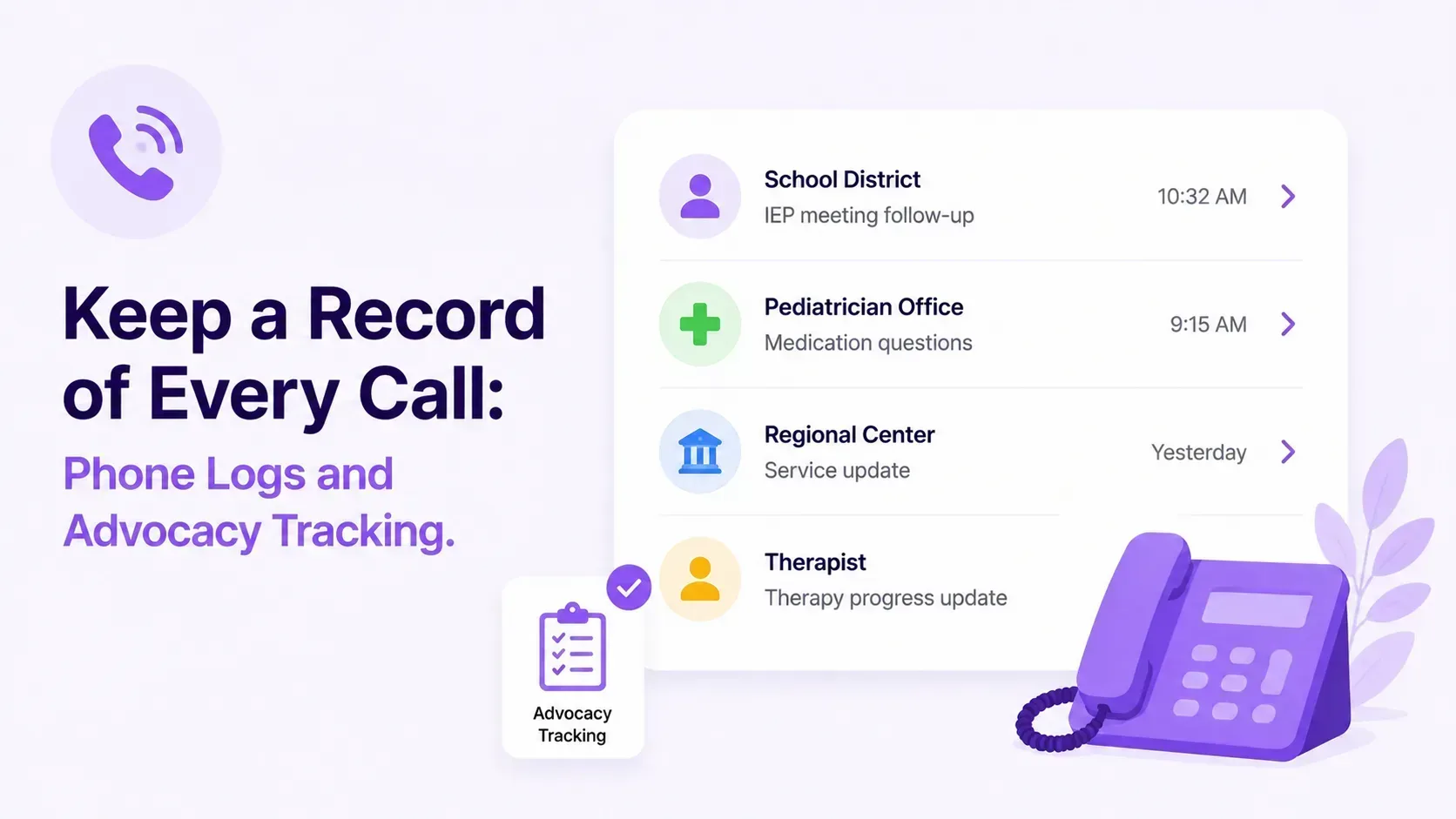
If you're raising a child with medical needs, developmental differences, or special education requirements, you already know the feeling — the stack of papers on the counter, the dates you're trying to hold in your head, the nagging sense that something important is slipping through the cracks.
You're not imagining it. And you're not alone.
Keeping a thorough record of your child's care journey is one of the most powerful things you can do as a parent — not because the system requires it, but because it gives you the information and confidence to advocate effectively at every step.
Your Memory Can't Do This Alone
Parents carry an enormous cognitive load. Between appointments, therapy sessions, school communications, medication changes, and everyday life, it's impossible to retain everything with perfect accuracy. And yet, the details matter enormously.
When your child's paediatrician asks what happened at last month's therapy session, or when a school administrator disputes what was agreed at the last IEP meeting, or when you need to demonstrate a pattern of behaviour to a new specialist — that's when documentation goes from "nice to have" to genuinely essential.
A record you made in the moment is always more reliable than what you can piece together weeks later.
Documentation Is How You Protect Your Child
Think of your records as a timeline that speaks for your child when you can't. They show progress. They reveal patterns. They prove what was promised and what was delivered.
Parents have used detailed records to:
- Identify that a child's challenging behaviour spiked every time a particular therapy schedule changed
- Demonstrate to a school district that agreed services weren't being provided
- Support an insurance appeal with documented medical necessity over time
- Brief a new doctor, therapist, or teacher quickly and accurately — without starting from scratch
These aren't rare situations. They happen to families every day. And the families who navigate them most effectively are almost always the ones who have been keeping records.
You Don't Have to Document Everything — Just the Right Things
The goal isn't to create a second job for yourself. It's to capture the moments and decisions that matter most:
- Appointments and outcomes — who you saw, what was discussed, what was recommended
- Therapy sessions — hours provided, goals worked on, any concerns raised
- School communications — emails, meeting notes, IEP documents and amendments
- Incidents and behaviours — dates, times, what happened before and after
- Medication and health changes — any adjustments and how your child responded
Even brief notes made consistently over time build into something extraordinarily valuable.
Start Where You Are
If the idea of getting organised feels overwhelming, start small. You don't need a perfect system on day one. A note on your phone after an appointment, a photo of a letter from school, a quick entry at the end of the day — these small acts add up.
What matters most is consistency over time, not perfection right now.
Your child's care journey is long. The records you keep today will be the foundation you build on for years to come — and the evidence you reach for when it counts most.